
The Family Tree of AI
AI, machine learning, deep learning and generative AI.
In this lesson, you will learn the big words, and how they fit together. Artificial intelligence. Machine learning. Deep learning. Generative A I. People often use them as if they mean the same thing, but they do not. Let's put them in order, like a family tree, so that you never feel confused again.
- Four big words, often mixed up
- They are not the same thing
- One simple picture sorts them all
Four circles, one inside another
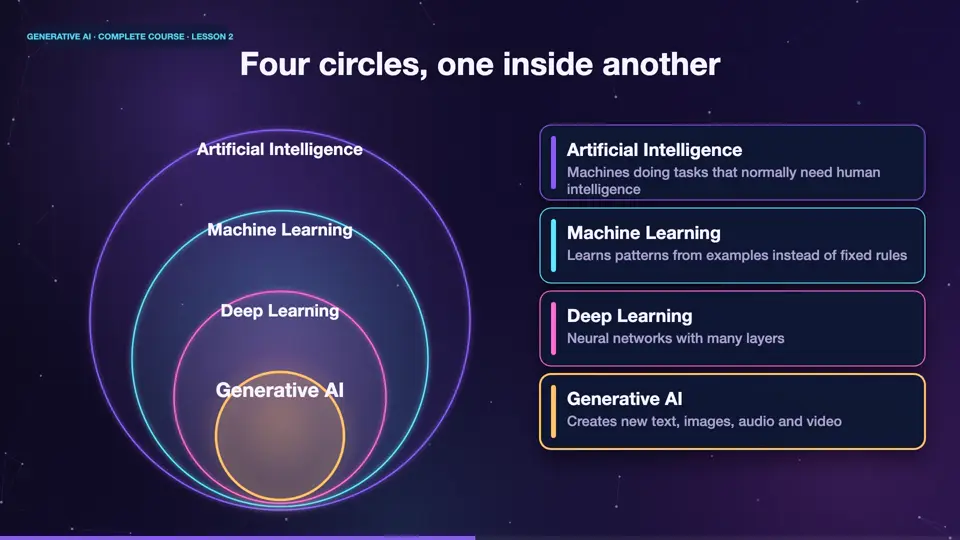
Think of four circles, one inside another. The biggest circle is artificial intelligence. It means any machine that does tasks which normally need human intelligence, like playing chess, or recognising speech. Inside it lives machine learning. Instead of following rules written by people, these systems learn patterns from examples. Inside that lives deep learning, which uses neural networks with many layers. And inside deep learning, we find generative A I, the part that creates new things. So every generative A I is deep learning, every deep learning is machine learning, and all of it is artificial intelligence.
Rules or examples?
Why did machine learning change everything? Because of how it solves problems. In the old way, a programmer writes every rule by hand. To spot spam, you might write, if the email says free money, block it. But spammers change their words, and you must write rules forever. In the new way, you show the computer thousands of examples of spam, and of normal emails. The computer finds the patterns by itself. You give it examples, and it writes its own rules.
Rules written by people
- if "free money" then block
- Hundreds of rules to maintain
- Breaks when spammers change words
- Limited by our imagination
Learning from examples
- Thousands of spam and normal emails
- Finds the patterns by itself
- Adapts when new data arrives
- Improves with more data
A short history of AI
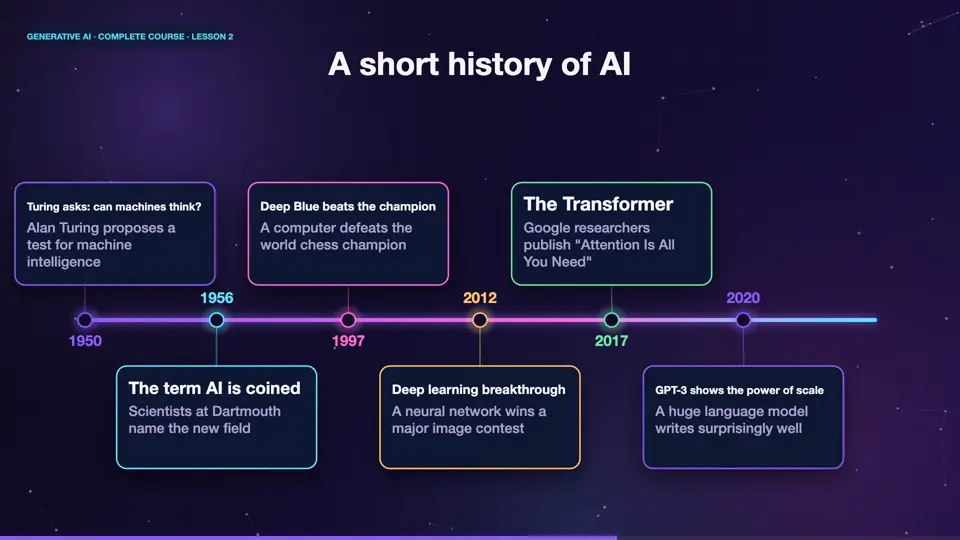
This is not a new dream. In nineteen fifty, Alan Turing asked a famous question. Can machines think? A few years later, a group of scientists coined the term, artificial intelligence. In nineteen ninety seven, a computer called Deep Blue beat the world chess champion. In twenty twelve, deep learning had its breakthrough, when a neural network won a major image contest. In twenty seventeen, researchers at Google published the transformer, the invention behind almost every modern language model. In twenty twenty, GPT three showed what very large models can do. And in twenty twenty two, chat tools reached millions of people, and generative A I went mainstream.
- 1950Turing asks: can machines think?Alan Turing proposes a test for machine intelligence
- 1956The term AI is coinedScientists at Dartmouth name the new field
- 1997Deep Blue beats the championA computer defeats the world chess champion
- 2012Deep learning breakthroughA neural network wins a major image contest
- 2017The TransformerGoogle researchers publish "Attention Is All You Need"
- 2020GPT-3 shows the power of scaleA huge language model writes surprisingly well
- 2022Chat tools go mainstreamMillions try generative AI for the first time
Summary
Well done. You can now tell the family apart. Artificial intelligence is the biggest circle, machine learning learns from examples, deep learning uses many layers, and generative A I creates new content. And you have seen the road that led here. Next, we reveal the surprisingly simple idea at the heart of every language model.
Key takeaways- AI > ML > Deep Learning > GenAI
- ML learns from examples, not rules
- A story of 70 years, with a sudden boom