
Music and Sound
How AI makes audio.
Music is patterns in time, which is exactly what these models are good at. Today, you can describe a song in words, and receive a finished track. In this lesson, you will learn how it works, and what it means for musicians, and listeners.
- Music is patterns in time
- From a sentence to a song
- What it means for creators
How models create audio
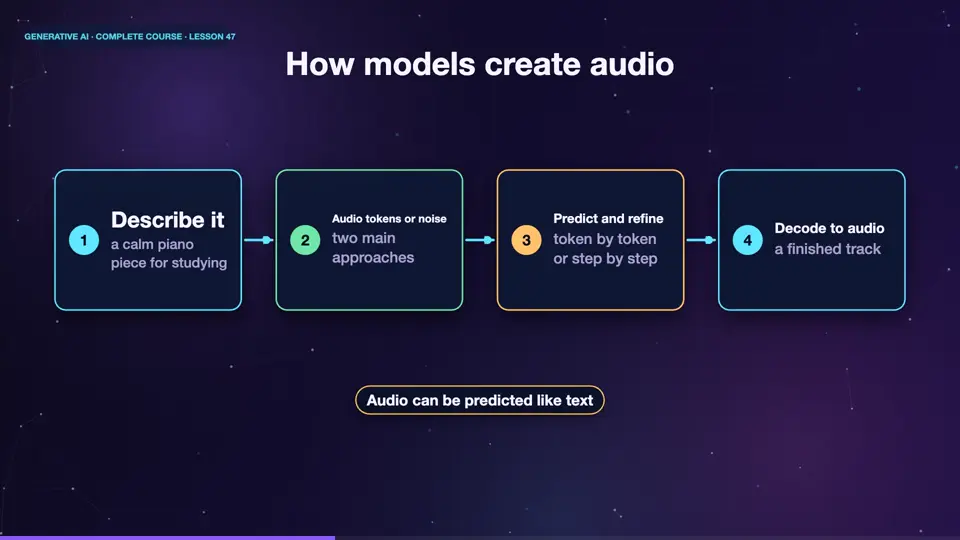
There are two main ways. Some models treat sound like language. They split audio into small pieces, called audio tokens, and predict the next token, again and again, just like a text model. Others use diffusion, starting from noise, and shaping it into sound, guided by your description. Either way, the model has learned from enormous collections of recorded music, and sound.
- Describe ita calm piano piece for studying
- Audio tokens or noisetwo main approaches
- Predict and refinetoken by token or step by step
- Decode to audioa finished track
What can be created
The range is wide. Full songs, with vocals and lyrics. Background music for videos and games. Sound effects, like rain, footsteps, or a door creaking. Voice overs in many languages. And tools that separate a song into vocals, drums, and bass. Many creators use these tools for drafts, and ideas, then polish the results by hand.
Questions about music and ownership
This area raises hard questions. Were the models trained on music, with permission? Who owns a song, that a machine helped create? How should artists be paid, when their style is imitated? Laws, and industry agreements, are still catching up. A sensible approach, for now, is to read the terms of any tool, credit the use of A I, and respect artists, and their work.
Open questions
- Was training data licensed?
- Who owns the result?
- How are artists paid?
- Laws are still evolving
Sensible habits
- Read the tool's terms
- Credit the use of AI
- Support human artists
- Avoid copying a living artist's voice
Summary
Good. Audio models predict sound tokens, or denoise audio, guided by text. They can create songs, effects, and voice overs, and raise real questions about rights. Next, the most demanding challenge of all, video.
Key takeaways- Audio tokens or diffusion
- Songs, effects, voice-overs, stems
- Respect rights and read the terms