
Prompting Techniques
The methods professionals use.
Once you know the basic recipe, a few techniques can lift your results even higher. In this lesson, you will learn four of the most useful. Zero shot, few shot, chain of thought, and self checking.
- Zero-shot and few-shot
- Chain of thought
- Self-checking
Zero-shot versus few-shot
Zero shot means you just ask, with no examples. Classify this review as positive or negative. This works well for simple tasks. Few shot means you show a few examples first. Here are three reviews, with their labels. Now classify this new one. The examples teach the exact format, and the exact style you want. Few shot is especially powerful, when the task is unusual, or the output must be consistent.
Zero-shot
- Just ask, no examples
- Works for simple tasks
- Fast to write
- Output format may vary
Few-shot
- Show 2 to 5 examples first
- Great for unusual tasks
- Teaches the exact style
- Output is consistent
Few-shot in action
Here is few shot in action. We show the model two examples. A sentence, and the emoji that matches. Then we give a new sentence. The model follows the pattern, and answers with a fitting emoji. We never explained the rule, we simply showed it. The model spotted the pattern, from the examples.
Chain of thought
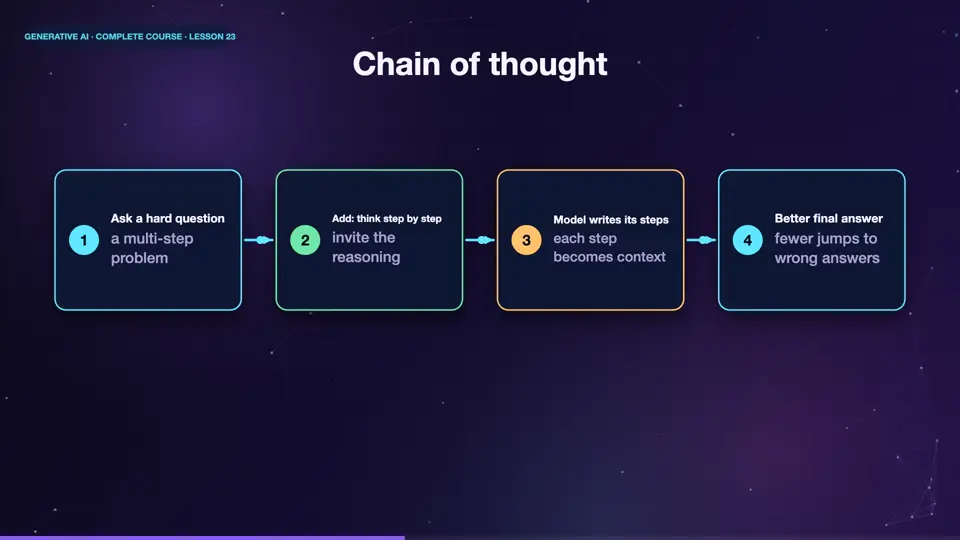
Some problems need steps. If you ask a model, a tricky word problem, it may jump to a wrong answer. But if you add, let's think step by step, it writes out its reasoning first, and the answer is much more often correct. Why? Because each written step becomes part of the context, so the model can build on its own reasoning, instead of guessing in one leap.
- Ask a hard questiona multi-step problem
- Add: think step by stepinvite the reasoning
- Model writes its stepseach step becomes context
- Better final answerfewer jumps to wrong answers
Self-checking and role switching
Two more tricks. First, ask the model to check itself. After it answers, say, review your answer for mistakes, and correct any you find. It often catches its own errors. Second, ask it to play a critic. Write the email, then act as a strict editor, and improve it. Having the model argue with itself, often gives a polished result.
Summary
Excellent. Zero shot just asks. Few shot shows examples. Chain of thought asks for step by step reasoning. And self checking asks the model to review its own work. Next, we turn all this into reusable patterns, and learn to get answers in exactly the format you need.
Key takeaways- Few-shot: show examples
- Chain of thought: think step by step
- Ask the model to check itself