
Bias and Fairness
Making AI fair for everyone.
A model learns from human writing, and human writing contains human bias. If we are not careful, A I can repeat old unfairness, at a huge scale. In this lesson, you will learn where bias comes from, how to spot it, and what to do about it.
- Models learn from human writing
- Human writing contains bias
- Spot it, and reduce it
Where bias comes from
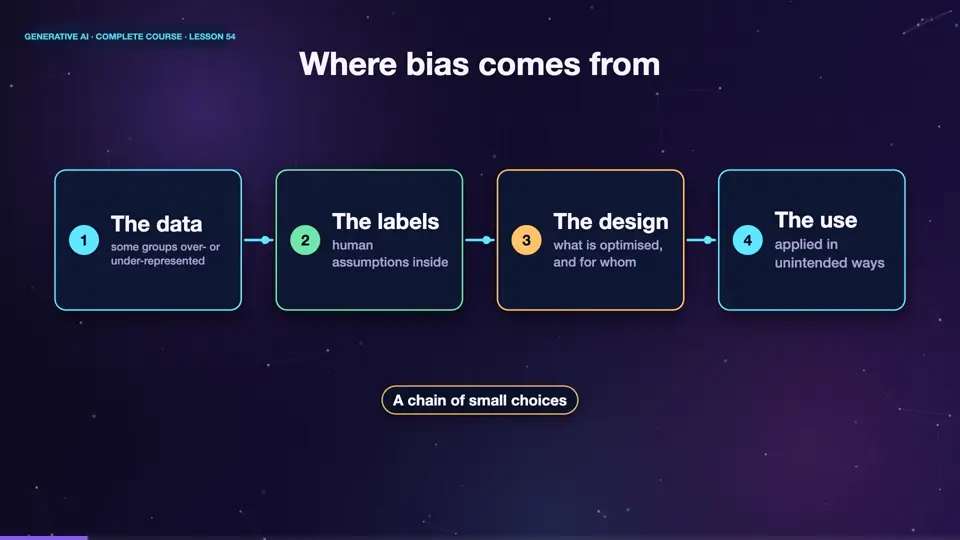
Bias can enter at every stage. The data may over represent some groups, and ignore others. The labels, written by people, may carry their assumptions. The design choices, such as what the system is asked to optimise, may favour some people. And the way a tool is used, may create new harm. Bias is rarely one mistake. It is a chain of small ones.
- The datasome groups over- or under-represented
- The labelshuman assumptions inside
- The designwhat is optimised, and for whom
- The useapplied in unintended ways
Examples to recognise
Some examples. An image generator, asked for a doctor, mostly shows men, and for a nurse, mostly shows women. A hiring tool, trained on past decisions, learns to prefer the kind of people who were hired before. A voice assistant, understands some accents better than others. In each case, the system looks neutral, but treats people differently.
Images
- "A doctor" shows mostly men
- "A nurse" shows mostly women
- Reinforces stereotypes
Decisions and speech
- Hiring tools copy past patterns
- Some accents are understood worse
- Looks neutral, treats people unequally
What helps
There is a lot that teams can do. Use diverse, balanced data. Test results for every group, not only on average. Include different voices in the design, and in the testing. Explain how decisions are made, where possible. Keep a human in the loop, for important decisions. And listen to the people affected, and fix problems quickly.
Summary
Good. Bias enters through data, labels, design, and use. It shows up in images, decisions, and speech. Teams reduce it with balanced data, group by group testing, diverse voices, and human oversight. Next, another serious risk, misinformation, and deepfakes.
Key takeaways- Bias: data, labels, design, use
- Test every group, not the average
- Humans stay in the loop