
Reasoning Models
Models that think before they answer.
Some questions cannot be answered in one quick guess. A hard maths puzzle needs steps. A new kind of model, called a reasoning model, is trained to think before it answers. In this lesson, you will see what that means, and when it helps.
- Hard problems need steps
- Models that think first
- When thinking helps
Thinking step by step
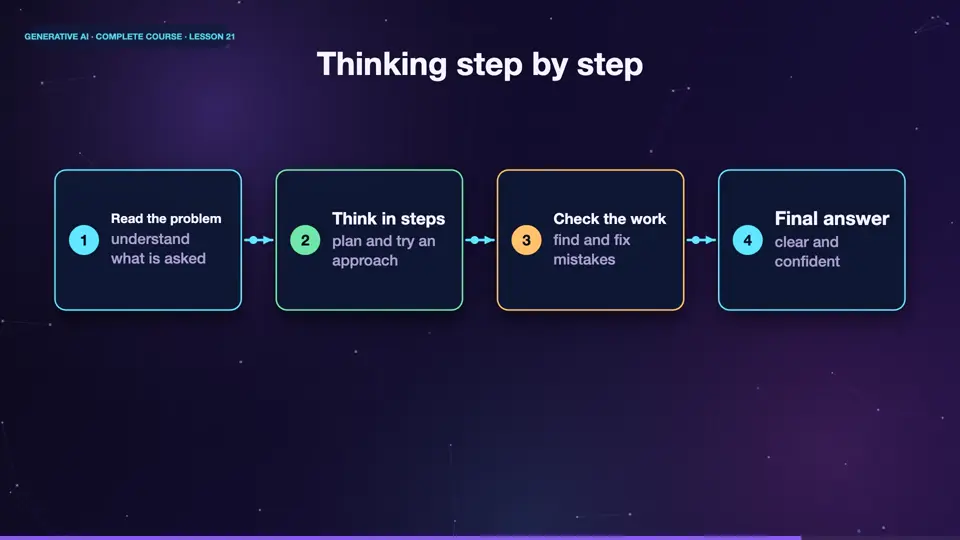
A normal model replies immediately, one token after another. A reasoning model first writes out a long chain of thought. It breaks the problem into steps. It tries an approach. It checks its own work. It may notice a mistake, and correct it. Only then does it give the final answer. All that extra thinking uses more tokens, and more time, but it makes hard problems solvable.
- Read the problemunderstand what is asked
- Think in stepsplan and try an approach
- Check the workfind and fix mistakes
- Final answerclear and confident
Fast model or thinking model?
So which should you use? A fast model is perfect for everyday tasks, like writing an email, summarising a page, or answering a simple question. A reasoning model shines on maths, logic puzzles, tricky code, planning, and anything with many steps. The price is speed, and cost. A good rule is to start with the fast model, and switch to the thinking one, only when the answer seems wrong, or the problem is hard.
Fast model
- Everyday writing and questions
- Instant answers
- Lower cost
Reasoning model
- Maths, logic, tricky code, planning
- Takes time to think
- Higher cost, stronger results
Summary
Great. Reasoning models think in steps before answering, checking and correcting themselves. They shine on multi step problems, at the price of time and cost. You now understand how modern language models work, from tokens, to attention, to training, and thinking. Next, we move from theory to practice, and learn to talk to these models, with prompts.
Key takeaways- Reasoning models think before answering
- Best for maths, logic, code, planning
- Start fast, switch when needed