
Video Streaming: Upload
From file to formats.
Our next case study is video streaming, like YouTube. A creator uploads one big video file. Millions of viewers watch it on phones, laptops, and TVs, on fast and slow connections. That one file needs a lot of work first.
- One big upload
- Millions of viewers
- Many devices and speeds
The upload pipeline
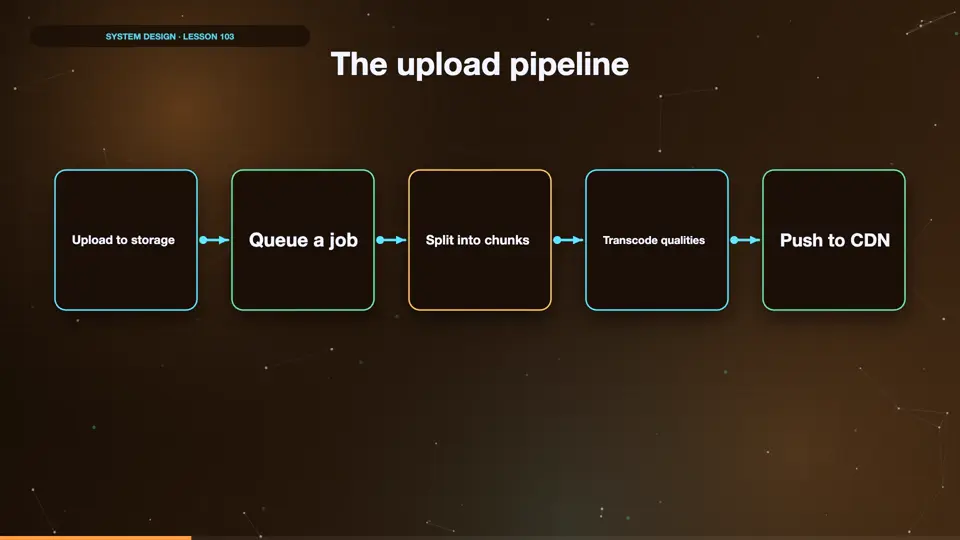
The creator uploads the original file straight to object storage, using a special upload link. A message on a queue starts the processing. Workers split the video into short chunks, and transcode each chunk into several qualities, like two forty p, four eighty p, ten eighty p, and four K. The results go back to object storage, and out to the CDN.
- Upload to storage
- Queue a job
- Split into chunks
- Transcode qualities
- Push to CDN
Why chunks
Splitting into chunks, a few seconds each, helps a lot. Many workers can transcode different chunks in parallel, so a long video is ready much sooner. A failed chunk can be redone on its own. And as we'll see, chunks are exactly what the player needs for smooth playback.
| key | value |
|---|---|
| Parallel | many workers at once |
| Retry | one chunk, not the whole video |
| Faster | ready sooner |
| Playback | players load chunks |
Summary
Uploads go straight to object storage, then a queue of workers splits and transcodes them into several qualities. Next, playing the video smoothly.
Key takeaways- Upload to storage
- Chunk and transcode
- Several qualities