
Clients and Servers
Who asks, who answers.
Almost every system you'll design is built from two roles. A client asks for something. A server answers. Your phone, your browser, and even another server can be a client.
- A client asks
- A server answers
- Almost every system
One request, one response
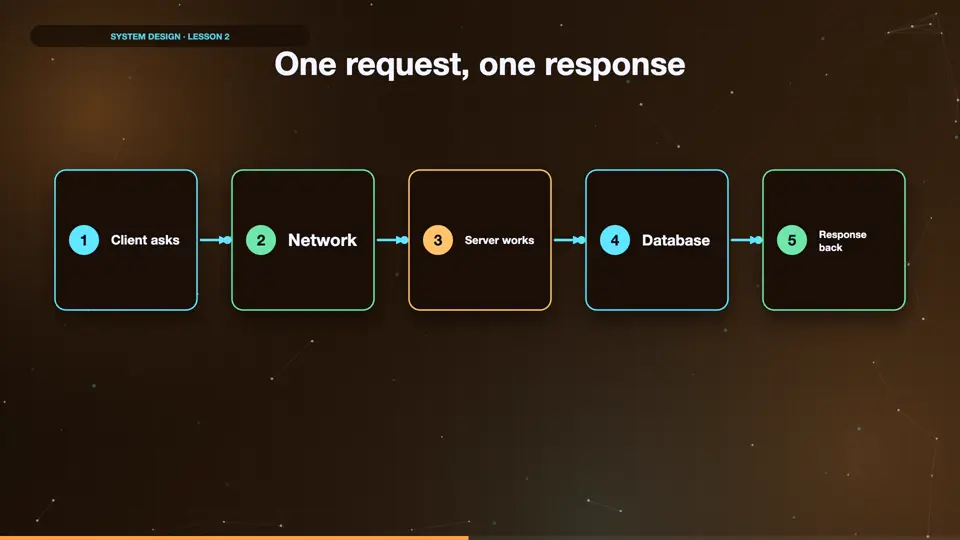
Here's the basic pattern. The client sends a request, for example, show me my orders. The request travels over the network. The server does the work, maybe reading from a database. Then it sends back a response, and the client shows it on screen.
- Client asks
- Network
- Server works
- Database
- Response back
Client vs server
The two sides have different jobs. The client is close to the user. It shows things, and collects input, but you can't trust it, because users control it. The server is controlled by you. It holds the real data, checks the rules, and must be always on.
Client
- Close to the userShows and collectsCan't be trusted
Server
- Controlled by youHolds real dataAlways on
Summary
Clients ask, servers answer, and the network sits between them. Next, we follow one click all the way from your browser to a server and back.
Key takeaways- Client sends a request
- Server sends a response
- Never trust the client