
Your Roadmap
From here to expert.
You have covered a huge amount. Let's look back at the journey, and then forward, to what comes next. Every expert practises, builds, and keeps learning. In this final lesson, you will get a clear plan for the next months.
- Look back at the journey
- Plan the next months
- Keep building
The journey you completed
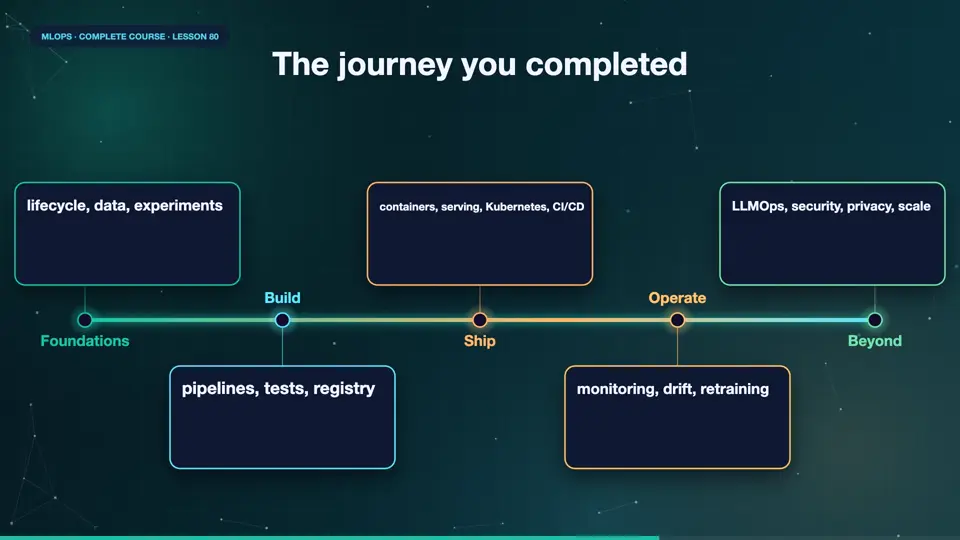
Look at what you have done. You began with a model that decayed in a week. You learned the life cycle, and versioned data, and validated it. You tracked experiments, built pipelines, and tuned models. You used a registry, tested models, and packaged them. You served them, deployed them, and automated delivery. You monitored, detected drift, and retrained. You studied language models, security, privacy, and cost. And you built a complete project. That is a full course.
- Foundationslifecycle, data, experiments
- Buildpipelines, tests, registry
- Shipcontainers, serving, Kubernetes, CI/CD
- Operatemonitoring, drift, retraining
- BeyondLLMOps, security, privacy, scale
A plan for the next months
Here is a simple plan. First month, rebuild the capstone, from memory, with your own dataset, and break it on purpose, to learn to debug. Second month, add one advanced piece, a feature store, a streaming feature, or an inference server. Third month, deploy it somewhere real, with monitoring, and let it run, for weeks. Watch what actually goes wrong. And share what you learn, in a write up, or a talk. Teaching others is the fastest way to master anything.
- Month 1: rebuildyour own data, break things
- Month 2: add depthfeatures, streaming, serving
- Month 3: run it for realmonitor, watch, learn
- Share itwrite, talk, teach
Where to keep learning
A few good places to continue. The documentation of the tools you used, D V C, M L flow, and Kubernetes, which have excellent tutorials. Open source projects, where you can read real pipelines. Public post mortems from companies, which teach more than any textbook. Community groups and conferences. And, above all, your own projects, running somewhere real. Nothing replaces watching a model you built, face the real world.
Congratulations. You started with a model that quietly broke. Now you know how to keep one healthy, from the first experiment, to years in production. Go build something. Monitor it. Improve it. And keep learning. Thank you for learning with me, and see you in the next course.
Summary
Congratulations, you have completed this complete M L Ops course. Thank you, for learning with me. Keep practising, keep building, and keep being curious.
Key takeaways- Lifecycle to monitoring
- Real tools, real terminals
- Ready to build and operate