
Large Organisations
Governance at scale.
In a large organisation, hundreds of models run across many teams, in regulated industries, under audit. The tools are the ones you know. What changes is scale, governance, and coordination. In this lesson, we look at what is different, so that you recognise it, if you ever join, or build for, such a place.
- Hundreds of models
- Regulation and audit
- Coordination at scale
What changes at scale
At large scale, a few things change. Inventory. You must know every model, its owner, its purpose, and its risk level. Governance. High risk models need reviews, approvals, and documentation, before they go live. Multi tenancy. Many teams share clusters, so quotas, isolation, and cost allocation are essential. Reliability. Service levels, on call rotations, and incident processes become formal. And standardisation. Shared libraries, templates, and reviews keep hundreds of projects from drifting apart.
Risk-based governance
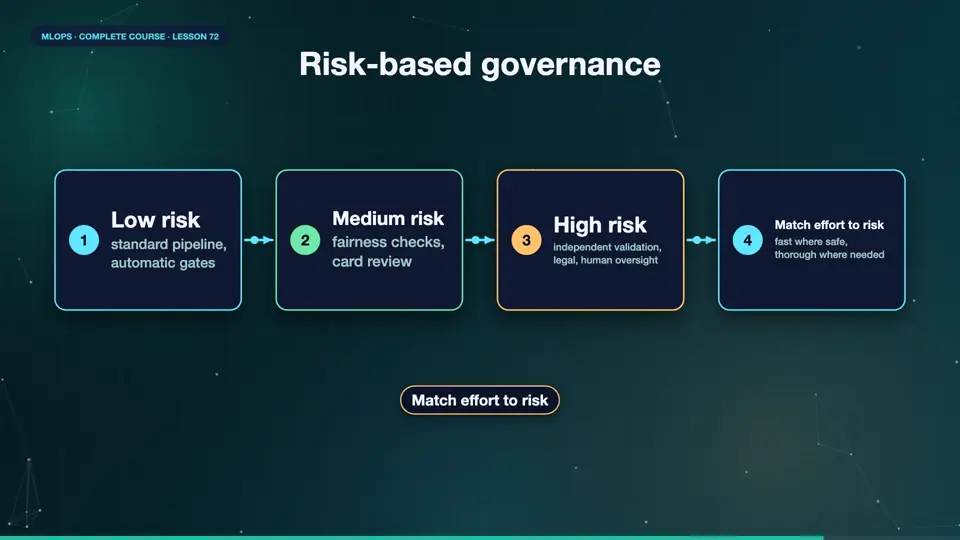
Not every model deserves the same scrutiny. A good scheme tiers them by risk. A low risk model, like a recommendation of articles, follows the standard pipeline, with automatic gates. A medium risk model, like a marketing offer, adds fairness checks, and a model card review. A high risk model, like a credit decision, or a medical triage, adds independent validation, legal review, human oversight, and strict monitoring. Matching effort to risk keeps the process fast for most models, and thorough where it matters.
- Low riskstandard pipeline, automatic gates
- Medium riskfairness checks, card review
- High riskindependent validation, legal, human oversight
- Match effort to riskfast where safe, thorough where needed
Centralised or federated?
Organisations choose how to arrange their teams. A central M L team serves the whole company. It concentrates expertise, and keeps standards consistent, but can become a bottleneck, and be far from business problems. Embedded teams sit inside each business unit. They know the domain deeply, and move fast, but may duplicate work, and drift apart in quality. Many large companies choose a hybrid. Embedded data scientists, in each unit, supported by a central platform and governance team, that offers tools, standards, and review.
Central team
- Expertise concentrated
- Consistent standards
- Can become a bottleneck
- Distance from the business
Embedded teams
- Deep domain knowledge
- Fast, close to the problem
- May duplicate work
- Quality can drift apart
Summary
Excellent. At scale, you need inventory, risk based governance, multi tenancy, formal reliability, and standard templates, with a hybrid of central and embedded teams. The same ideas, applied with more structure. Now a set of quizzes, to check what you remember, and your final roadmap.
Key takeaways- Inventory and risk tiers
- Multi-tenancy and formal SLOs
- Hybrid team structure