
A Small Team Setup
One or two people, no platform.
Everything in this course can feel like a lot of machinery. If you are a team of one, or two, you do not need a platform. You need a few good habits, and a handful of simple tools. In this lesson, we design the smallest sensible setup, that gives you most of the benefits, with almost no operations burden.
- No platform needed
- A few good habits
- Most of the benefit, little burden
The smallest sensible setup
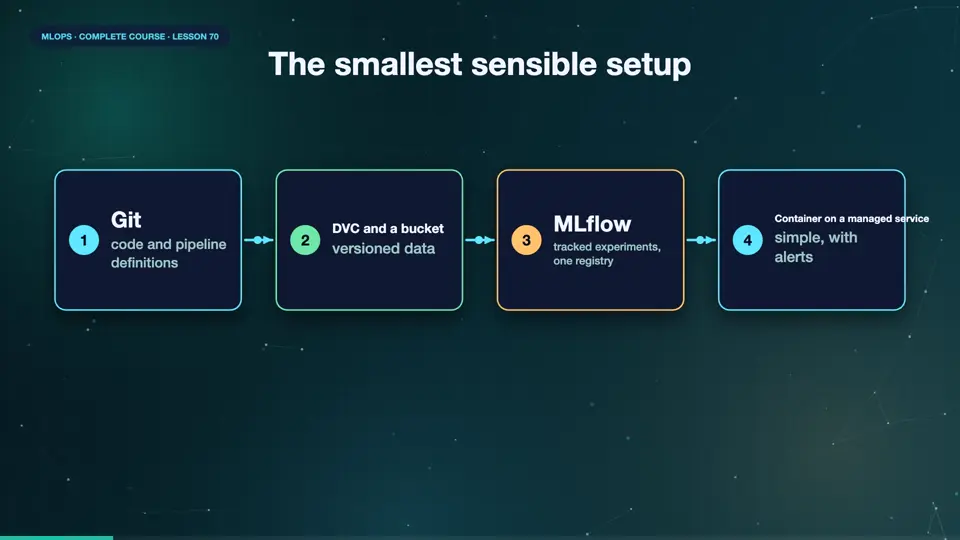
Here is the smallest sensible setup. Code and pipeline definitions live in Git. Data is versioned with D V C, stored in a cheap bucket. Training runs from a pipeline, on a laptop, or a single cloud machine. Experiments are tracked in a local, or small hosted M L flow. The best model is exported, and packaged in a container. And it runs on a simple managed service, a single container service, with a health check, and basic alerts. Everything else, you add only when the pain appears.
- Gitcode and pipeline definitions
- DVC and a bucketversioned data
- MLflowtracked experiments, one registry
- Container on a managed servicesimple, with alerts
One Makefile to rule them all
A surprisingly effective tool for small teams is a simple make file. Each target is a command anyone can remember. Data pulls the data, and prepares it. Train depends on data, and runs the pipeline. Test runs the tests. Serve builds the container, and runs it. And monitor runs the drift check, and tells you what to do if it finds drift. New team members learn the whole workflow in a minute, and the same commands work on a laptop, and in a C I job. Simple, and boring, which is exactly right.
.PHONY: data train test serve monitor

data:
	dvc pull && python src/prepare.py

train: data
	dvc repro

test:
	pytest -q

serve: train
	docker build -t churn-api . && docker run -p 8000:8000 churn-api

monitor:
python src/drift.py || echo "drift found: run make train"What small teams should skip
Just as important is what to skip. Skip the feature store, until features are shared by several models. Skip Kubernetes, if a managed container service is enough. Skip streaming, until freshness truly matters. Skip a custom platform, because managed services cover most needs. Spend the saved effort on what always pays off, tests, data validation, monitoring, and a quality gate. A small, well tested pipeline beats a large, untested platform.
Summary
Good. A small team needs Git, versioned data, a pipeline, a tracker, a container, and monitoring, and one make file to run them. Skip the heavy machinery until the pain appears. Next, the setup for a growing team, with a shared platform.
Key takeaways- Git, DVC, MLflow, container
- A Makefile as the interface
- Skip heavy machinery at first