
The ML Lifecycle
The map of the whole journey.
Every machine learning project follows the same journey, whether it is for movie recommendations, or fraud detection. Knowing the journey is like having a map of the course. Each later clip explores one part of it. Let's walk through it once, from start to finish, and back again.
- The same journey every time
- Eight stages in a loop
- A map for the whole course
The lifecycle is a loop
Here is the lifecycle. First, define the problem, and how success is measured. Second, collect and prepare data. Third, build features, the inputs for the model. Fourth, train and tune models, and evaluate them. Fifth, package the best model. Sixth, deploy it, so that applications can use it. Seventh, monitor it, in production. And eighth, learn from what you see, and go around again, with new data. It is a loop, not a line, and the loop never stops.
- Defineproblem and success measure
- Datacollect, clean, version
- Trainfeatures, models, evaluation
- Deploypackage and serve
- Monitordrift and quality
Where each part is covered
Let's connect the stages to the course. Data and experiments come first, versioning, validation, and tracking. Then pipelines, tuning, registries, and testing. Then serving, containers, and Kubernetes, with automated delivery. Then monitoring, drift, and retraining. And finally, governance, cost, and the new world of large language model operations. By the end, you will have touched every stage of the loop.
| Stage | Topics in this course |
|---|---|
| Data and experiments | versioning, validation, tracking |
| Training | pipelines, tuning, registry, testing |
| Serving | packaging, APIs, Kubernetes, CI/CD |
| Monitoring | metrics, drift, retraining |
| Beyond | governance, cost, LLMOps |
Three maturity levels
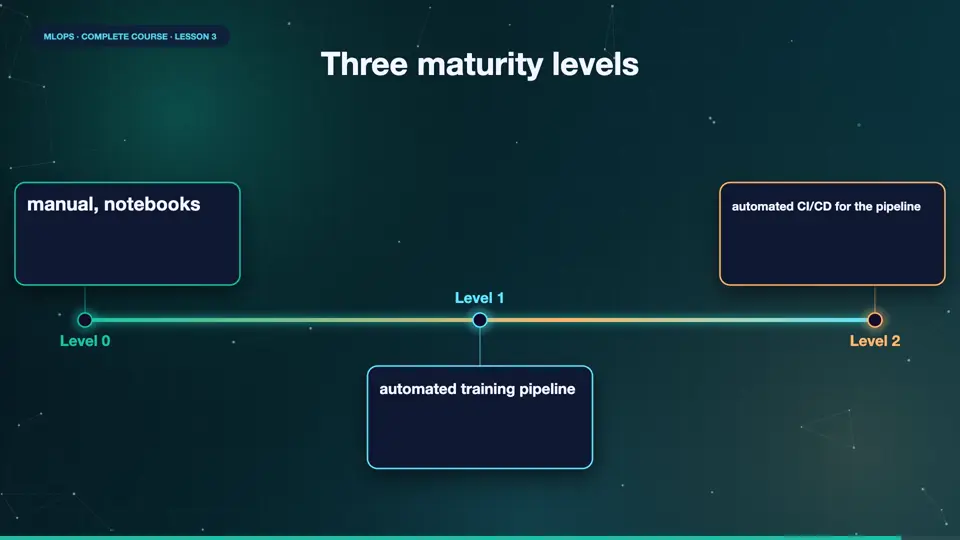
Teams grow through three levels of maturity. Level zero is manual. A data scientist trains in a notebook, and hands a file to engineers. It works, but it is slow, and fragile. Level one automates the training pipeline, so models can be retrained from fresh data, on a schedule. Level two also automates building, testing, and deploying the pipeline itself, so that changes ship safely, in minutes. You will not need level two on day one. But you should know the direction.
- Level 0manual, notebooks
- Level 1automated training pipeline
- Level 2automated CI/CD for the pipeline
Summary
Excellent. The life cycle is a loop, from problem, to data, training, deployment, monitoring, and back again. Teams mature from manual, to automated training, to fully automated delivery. Next, we get practical, with the project and the tools we will use throughout the course.
Key takeaways- Eight stages in a loop
- Maturity: level 0, 1, 2
- Every stage is in this course