
Map-Reduce with Send
Many in parallel.
Map reduce has two phases. Map, process every item in parallel. Reduce, combine the results into one answer. With Send for the map, and a normal node for the reduce, it fits naturally in a graph.
- Map: each item
- Reduce: combine
- Send + a normal node
Pricing a basket
Fan out sends each basket line to the price line node. Each one works out its line total, in parallel. Then the edge to total waits for every branch. Total adds up the lines, and applies free delivery over twenty five pounds. Run it. Each line is priced, and the reduce step gives one final total.
import operator
from typing import Annotated, TypedDict
from langgraph.graph import StateGraph, START
from langgraph.types import Send

PRICES = {"Dune": 9.99, "Emma": 7.99, "Circe": 10.99}
class State(TypedDict):
    basket: dict
    lines: Annotated[list[float], operator.add]
    total: str

def fan_out(s): return [Send("price_line", {"title": t, "qty": q}) for t, q in s["basket"].items()]
def price_line(x): return {"lines": [round(PRICES[x["title"]] * x["qty"], 2)]}
def total(s):
    goods = round(sum(s["lines"]), 2)
    return {"total": f"lines {sorted(s['lines'])} = £{goods}, delivery {'free' if goods > 25 else '£2.99'}"}
b = StateGraph(State); b.add_node(price_line); b.add_node(total)
b.add_conditional_edges(START, fan_out, ["price_line"]); b.add_edge("price_line", "total")
print(b.compile().invoke({"basket": {"Dune": 2, "Emma": 1}, "lines": []})["total"])lines [7.99, 19.98] = £27.97, delivery free
Map-reduce shape
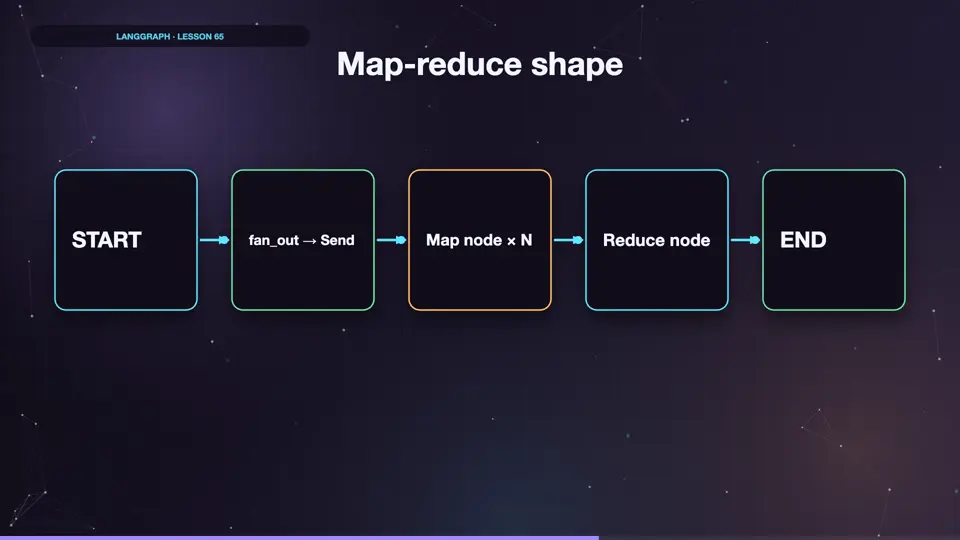
The shape is always the same. Start. A fan out function sends each item. The map node runs once per item, in parallel. The reduce node waits for all of them. Then the run ends.
- START
- fan_out → Send
- Map node × N
- Reduce node
- END
Summary
Map with Send, then reduce in a normal node that waits for every branch. Next, practise with model calls in the map step.
Key takeaways- Send for the map
- Reducer collects
- Reduce node combines