
Vision System Design
The interview question that matters.
A senior interview won't ask you what a convolution is. They'll say, design a system that counts people entering a shop. There's no single right answer. They want to see how you think. Here's a framework, with a full worked answer.
- Design a people counter
- No single right answer
- How you think matters
The framework
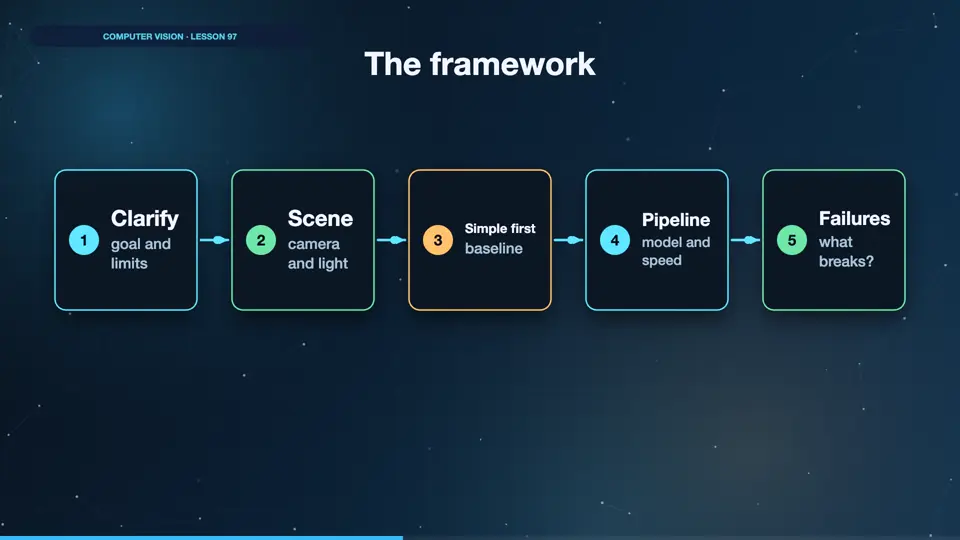
Start with questions. What's the goal, how accurate must it be, and what can we change? Then think about the camera and the scene. Then the simplest possible solution. Then the model and the pipeline. Then how you'd measure it. And finally, what could go wrong in the real world.
- Clarifygoal and limits
- Scenecamera and light
- Simple firstbaseline
- Pipelinemodel and speed
- Failureswhat breaks?
A worked answer
First, ask why. Counting for staffing can tolerate five percent error, and no identities are needed. So mount the camera overhead, pointing straight down. That removes faces, and solves privacy, and stops people from hiding behind each other. Use a small detector, on an edge device. Track the heads, and count line crossings, with each track counted once. Store only counts, never video.
Measuring and failing
To measure it, count by hand for an hour each day, for two weeks, and compare the numbers. Now list the failures. Groups walking together. Pushchairs. Staff going in and out all day. Sunlight at closing time. Each gets a test. And a daily comparison with till receipts will warn you if the camera gets moved. That's the kind of thinking that gets people hired.
Summary
Clarify, simplify, and plan for failure. Next, another worked example, from a different world.
Key takeaways- Ask why first
- Change the camera, solve the problem
- Name the failures