
Reading Vision Papers
Keeping up with the field.
Hundreds of vision papers appear each week. Nobody can read them all, and you don't need to. Experienced engineers don't read papers from start to finish. They've got a method.
- Hundreds of papers a week
- Nobody reads them all
- Experts have a method
Three passes
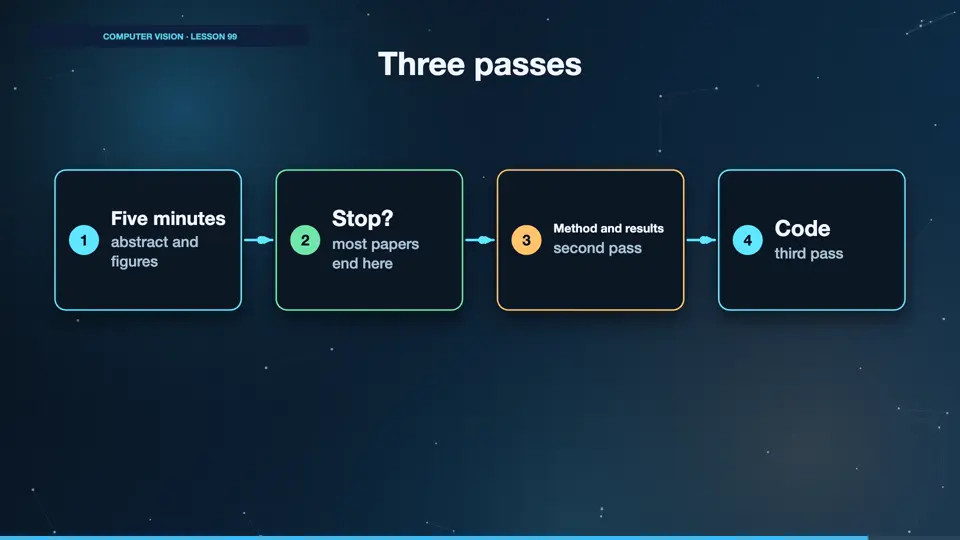
First pass, read the title, the abstract, the figures, and the conclusion. That takes five minutes, and for most papers, you'll stop there. Second pass, read the method, and the results. Third pass, only for papers that matter to you, work through the details, and find the code.
- Five minutesabstract and figures
- Stop?most papers end here
- Method and resultssecond pass
- Codethird pass
Reading critically
Be a little sceptical. Look at which dataset they used, and whether it resembles yours. Check the baseline, as a weak one makes anything look good. See if there's code. Ask how much compute was needed. And wait for others to repeat the result. A method that wins a benchmark by half a percent rarely matters in real work. Look for ideas, not decimal points.
Summary
Skim most, go deep on few, and stay sceptical. You've now got all of it. Next, your capstone.
Key takeaways- Three passes
- Most papers stop at one
- Look for ideas