
Running a Vision Project
From idea to launch.
Most vision projects never reach production. It's rarely because the model wasn't good enough. It's because nobody defined success, the data didn't match reality, or the people on the factory floor didn't trust it. Here's how to avoid that.
- Most projects never ship
- Rarely the model's fault
- How to avoid that
A project plan
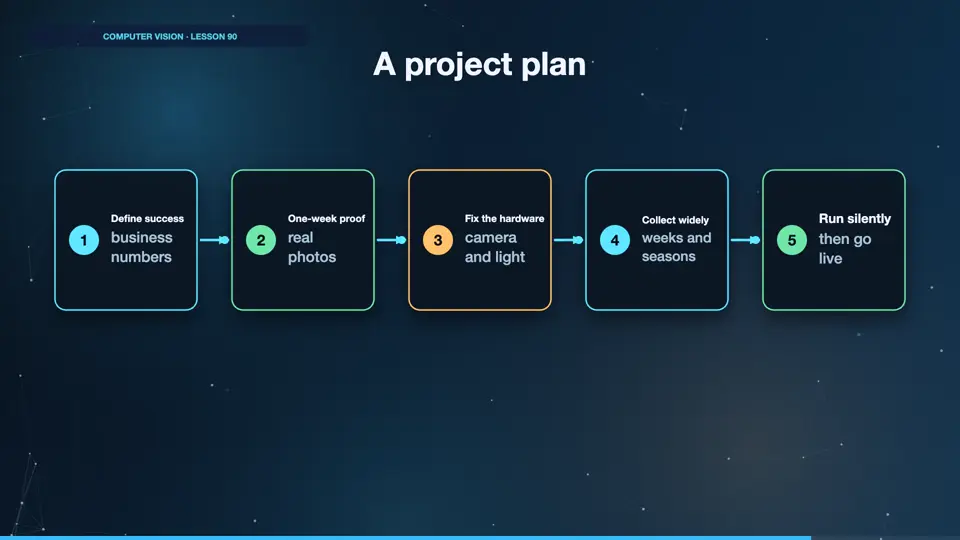
First, define success as a business number. Catch ninety percent of bruises, and waste under two percent. Second, run a proof of concept, in a week, on real photos. Third, set up the camera and lighting properly. Fourth, collect varied data, over weeks and seasons. Fifth, run it silently, alongside the old process. And only then, let it make decisions.
- Define successbusiness numbers
- One-week proofreal photos
- Fix the hardwarecamera and light
- Collect widelyweeks and seasons
- Run silentlythen go live
Working with people
The floor staff know things which no dataset contains. Talk to them first. Show them the mistakes, and ask why. Give them an easy way to correct the system. Their corrections become your best training data. And be clear about their jobs. A tool that makes them look good gets used. One that seems to threaten them gets switched off.
Budgeting honestly
Plan for where the time actually goes. Roughly speaking, data work takes the largest share. Integration with existing machines takes a lot more than people expect. Training the model is often one of the smallest parts. And after launch, maintenance never ends. If you tell people that up front, you'll be far more credible.
| key | value |
|---|---|
| Data work | the biggest share |
| Integration | often underestimated |
| Model training | surprisingly small |
| Maintenance | never ends |
Summary
Define success, test on real data, and win over the people who'll use it. Next, let's review what you've learned.
Key takeaways- Define success in business terms
- Run silently first
- Win over the people