
Recursive Splitting
Paragraphs first.
A smarter splitter tries to cut in natural places. First between paragraphs. If a piece is still too big, between lines. Then between sentences, then words. That's recursive splitting, and it's the most popular choice.
- Paragraphs first
- Then lines
- Then words
The recursive splitter
Recursive character text splitter takes a chunk size and an overlap. Split text returns the pieces. We split the returns page with a size of two hundred. Run it. Every chunk ends at a natural break, so no sentence is cut in half.
from pathlib import Path
from langchain_text_splitters import RecursiveCharacterTextSplitter

splitter = RecursiveCharacterTextSplitter(chunk_size=200, chunk_overlap=0)
text = Path("data/rag/northwind/returns.md").read_text()

for piece in splitter.split_text(text):
print(f"{len(piece):3} | {piece[:70]!r}")21 | '# Returns and refunds' 178 | '## Change of mind\nYou can return any unused item within 30 days of del' 101 | 'We charge a £25 collection fee to pick up a returned bike. Parts can b' 126 | '## Faulty items\nIf an item is faulty, you can return it at any time wi' 121 | '## Refund timing\nRefunds go back to the original payment method within' 85 | 'To start a return, log in to your account, open the order, and choose '
How it decides
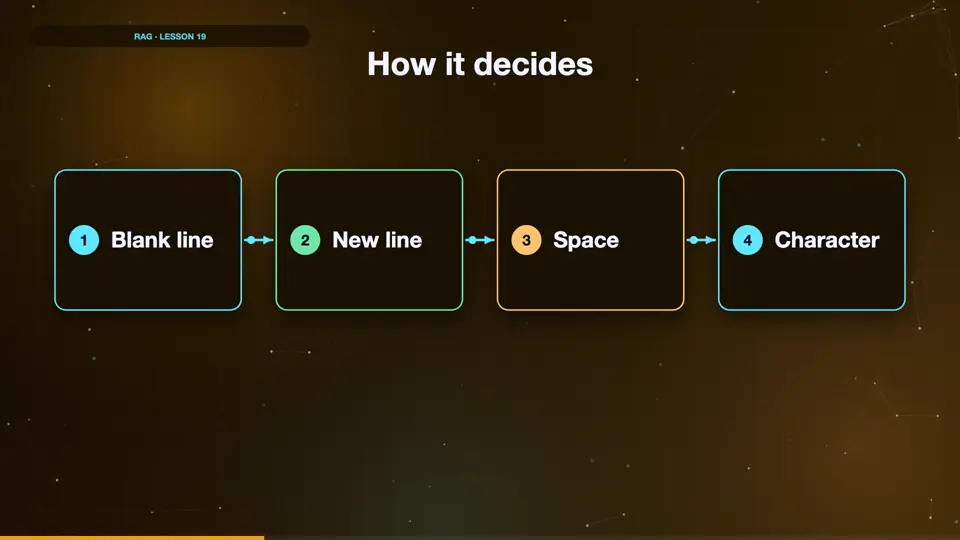
The splitter has a list of separators. It tries a blank line first, which separates paragraphs. Any piece still too big is split at single new lines. Then at spaces. And only as a last resort, between characters.
- Blank line
- New line
- Space
- Character
Summary
Recursive splitting cuts at the most natural break that keeps chunks under the size limit. Next, splitting by headings.
Key takeaways- Paragraphs first
- Under the size limit
- No half sentences