
When Not to Use an Agent
The most useful lesson here.
Agents are exciting, so people use them for everything. And that's a mistake. A team once spent months on an agent to sort emails, when a three line rule would've handled ninety percent of them. The best engineers reach for the simplest thing that works.
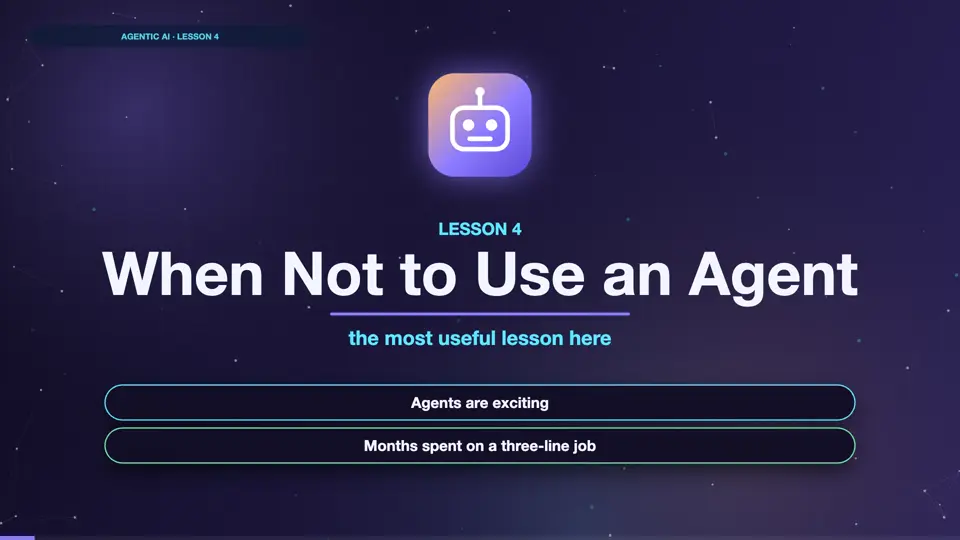
- Agents are exciting
- Months spent on a three-line job
- Use the simplest thing that works
Try plain code first
Many support messages don't need AI at all. A regular expression finds an order number. A keyword spots a question about hours. And anything else goes to a person. Run it. Instant, free, and it's never wrong in a surprising way. Always handle the easy cases with plain code first, then let an agent handle what's left.
import re

def route(message):
    match = re.search(r"\b[A-Z]\d{2}\b", message)
    if "where" in message.lower() and match:
        return f"Track order {match.group()}"
    if "hours" in message.lower():
        return "Open nine to five"
    return "Send to a person"

for m in ["Where is B42?", "What are your hours?", "My wheel wobbles at speed"]:
print(f"{m:<28} -> {route(m)}")Where is B42? -> Track order B42 What are your hours? -> Open nine to five My wheel wobbles at speed -> Send to a person
The maths of many steps
Agents have two hidden costs. Every step costs money and time. And every step can fail. Let's say each step works ninety seven percent of the time. That sounds great. Run it. Six steps, and we're down to about eighty three percent. Twenty steps, and it's barely more than half. That's why short agents beat long ones, and why tasks should be as small as possible.
steps = 6
model_call = 0.002
success_per_step = 0.97

cost = steps * model_call
success = success_per_step ** steps

print(f"Cost per task: ${cost:.3f}")
print(f"Cost for 300 tickets a day: ${cost * 300:.2f}")
print(f"Chance all six steps work: {success:.0%}")
print(f"With twenty steps: {success_per_step ** 20:.0%}")Cost per task: $0.012 Cost for 300 tickets a day: $3.60 Chance all six steps work: 83% With twenty steps: 54%
Which should you use?
Here's the decision. If the steps are always the same, write normal code. If they're the same, but one step needs judgment, use a workflow with a model in it. Use a real agent only when the steps can't be known in advance, when mistakes are recoverable, and when a person's time is worth more than the risk.
| Situation | Use |
|---|---|
| Same steps, no judgment | Plain code |
| Same steps, some judgment | Workflow |
| Steps not known in advance | Agent |
| Mistakes are expensive | Keep a human in the loop |
Summary
If the task is predictable, don't use an agent. If you do need one, keep it short. Now we'll get our hands dirty. Next, we'll talk to a real model.
Key takeaways- Handle easy cases with code
- Reliability falls with each step
- Use agents only when needed