LangChain Tutorial 120 lessons · 2:16:24+ of video
LangChain Home Getting Started
What Is LangChain How LLM Apps Work Setting Up Models and Messages
Your First Model Call Messages Conversations Settings, Streaming, Batches
Model Settings Streaming Batch Calls Tokens and Providers
Tokens and Usage Switching Providers Basics Quiz Prompt Templates
Prompt Templates Chat Prompt Templates MessagesPlaceholder Examples, Chains, Parsers
Few-Shot Prompts Chains with the Pipe Output Parsers Runnables
Runnables RunnableLambda RunnableParallel Passthrough, Routing, Fallbacks
RunnablePassthrough Routing Fallbacks and Retries Inside Chains and Practice
Seeing Inside a Chain Practice: Review Summariser Chains Quiz Structured Output
Why Structured Output Pydantic Models with_structured_output Shapes, Labels, Extraction
Lists and Nested Data Classification Extraction Structured Output in Practice
Batch Extraction When Output Goes Wrong Structured Output Quiz Tools
What Are Tools The tool Decorator Tool Schemas Tool Calls by Hand
Binding Tools Reading Tool Calls Running Tools Yourself Agents
The Agent Loop create_agent Several Tools Prompts, Streaming, Memory
Agent System Prompts Streaming Agent Steps Agent Memory Structured Answers and Middleware
Structured Agent Answers Middleware Built-in Middleware Context and Errors
Dynamic Prompts Tool Errors Runtime Context Agent Practice and Approval
Practice: Bookshop Agent Human Approval Agents Quiz RAG Foundations
What Is RAG Documents Loading Files Chunks and Embeddings
Splitting Text Chunk Size and Overlap Embeddings Similarity and Vector Stores
Similarity Vector Stores Search with Scores Retrievers
Retrievers Metadata Filters MMR Search Your First RAG Chain
Your First RAG Chain The RAG Prompt Saying I Don't Know Better RAG
Citing Sources Conversational RAG RAG as a Tool RAG in Practice
Saving a Vector Store Checking RAG Quality RAG Pitfalls FAQ Bot and Async
Practice: Bookshop FAQ Bot RAG Quiz Async Calls Cache, Limits and Timeouts
Caching Model Calls Rate Limiting Timeouts Cost, Logging and Tracing
Tracking Cost Callbacks for Logging Tracing with LangSmith Evaluation
Evaluating Answers Test Sets Comparing Prompts Safety
Prompt Injection Guardrails PII Redaction Reliability
Model Fallbacks Limiting Agent Calls Production Quiz Serving and the Project Plan
Serving with FastAPI Streaming over HTTP Project: Support Bot Plan Project: Building the Bot
Project: Knowledge Base Project: Tools Project: The Agent Project: Memory, Guardrails, Tests
Project: Memory Project: Guardrails Project: Testing Project Review and Good Habits
Project: Review Choosing Models Prompt Habits Images and Long Documents
Multimodal Input Long Documents Map-Reduce Summaries Rewriting and Extraction
Translation and Rewriting Data from Tables Applied Quiz The Bigger Picture
LangChain vs LangGraph The Ecosystem Cheat Sheet: Core Wrapping Up
Cheat Sheet: Agents and RAG Common Mistakes What to Learn Next LangChain · Lesson 5 of 120
Messages System, human, AI.
⏱ 2 min read ▶ Video at 4:12 🎓 Free
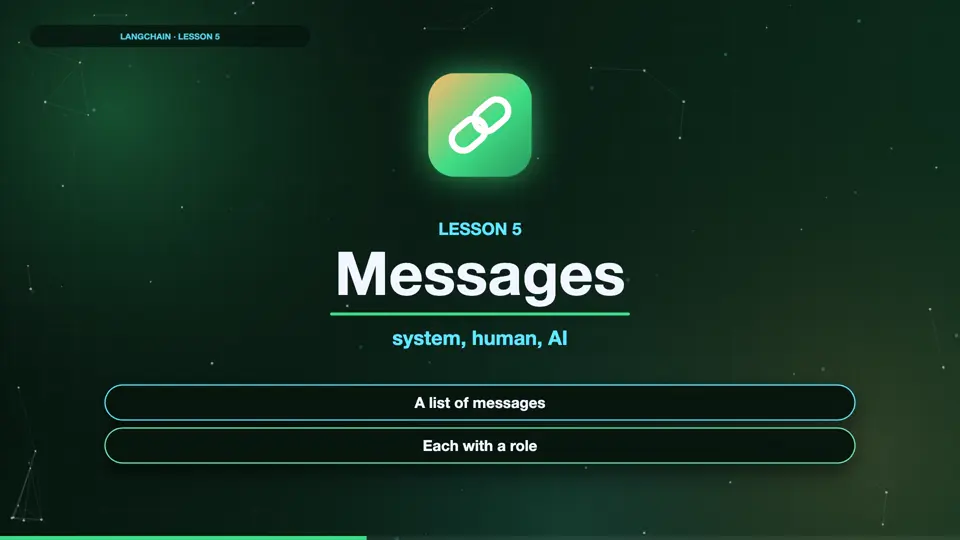
▶ starts at 4:12 Chat models don't just take one string. They take a list of messages, each with a role. The role tells the model who said what.
From the video: Messages A list of messages Each with a role Who said what There are three main roles. A system message sets the rules and personality, like, you are a friendly bookshop assistant. A human message is what the user says. And an AI message is what the model said before. Later, we'll meet a fourth, the tool message.
Role Class Purpose system SystemMessage rules and personality human HumanMessage what the user says ai AIMessage what the model said tool ToolMessage a tool's result (later)
Here we send two messages. The system message tells the model to answer like a pirate, in under fifteen words. The human message asks a simple question. Run it. The answer follows the rules from the system message. That's how you give an assistant its personality.
roles.py python Copy
from langchain.chat_models import init_chat_model from langchain.messages import SystemMessage, HumanMessage model = init_chat_model( "google_genai:gemini-flash-lite-latest" , temperature = 0 ) messages = [ SystemMessage( "You are a pirate. Answer in under 15 words." ), HumanMessage( "What is a library?" ), ] print (model.invoke(messages).text) Output
Ahoy! A treasure chest of stolen scrolls and silent maps, ye scallywag! Prefer to watch? The full LangChain course is free All lessons in one video with animations, real code and chapters.
Watch free Messages carry roles. System sets the rules, human is the user, and AI is the model. Next, using a list of messages to hold a whole conversation.
Key takeaways SystemMessage: rules HumanMessage: user AIMessage: model