
Hypothesis Testing
Innocent until proven.
A company changes its website, and sales go up a little. Did the change work, or was it just luck? Hypothesis testing is a careful way to answer, is this effect real, or could chance alone explain it?
- Sales went up a little
- Real, or just luck?
- Hypothesis testing
Like a court case
A court assumes the defendant is innocent, unless the evidence is strong. Hypothesis testing works the same way. The null hypothesis says nothing interesting is happening. No effect, no difference. We only reject it if the data would be very surprising under the null.
The steps
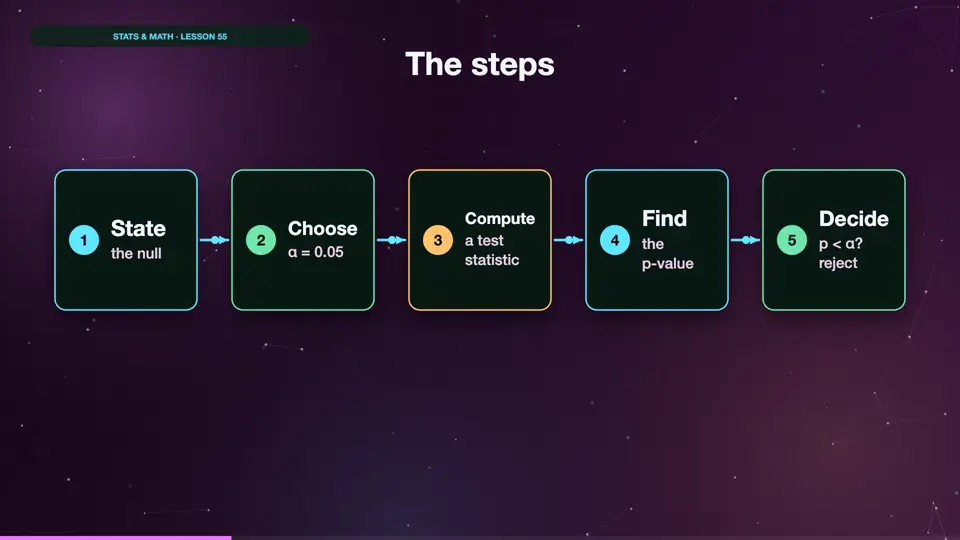
Every test follows the same steps. State the null hypothesis. Choose a significance level, usually five percent. Compute a test statistic from your data. Find the p value. And if the p value is below the significance level, reject the null.
- Statethe null
- Chooseα = 0.05
- Computea test statistic
- Findthe p-value
- Decidep < α? reject
Summary
A hypothesis test assumes no effect, and asks whether the data is surprising enough to reject that. Next, the p value.
Key takeaways- Null: no effect
- Evidence must be strong
- Reject, or don't