
Bayes' Theorem
Updating beliefs.
The chance that a sick person tests positive is not the same as the chance that a positive person is sick. People mix these up all the time, even doctors. Bayes' theorem shows how to go from one to the other.
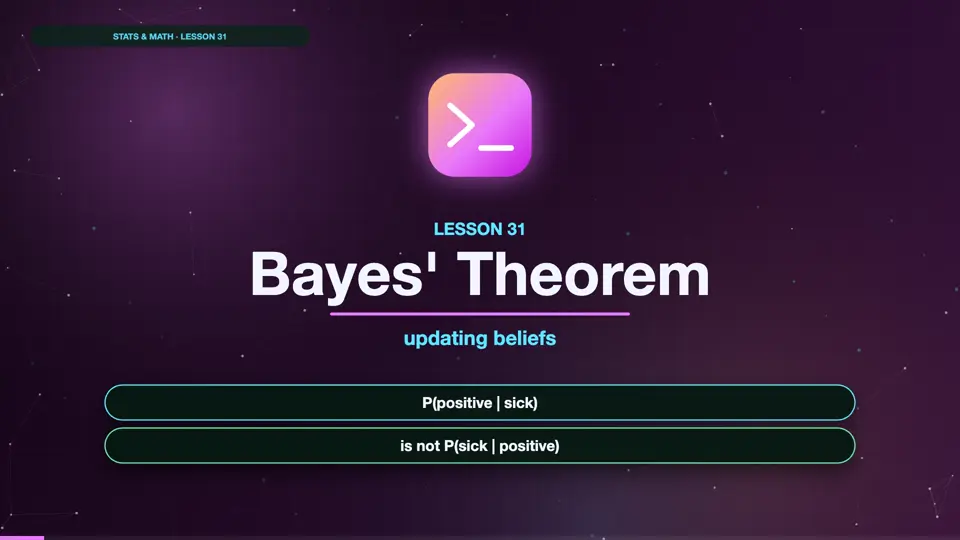
- P(positive | sick)
- is not P(sick | positive)
- Bayes flips it around
The formula
Bayes' theorem says the probability of A given B equals the probability of B given A, times the probability of A, divided by the probability of B. The probability of A is called the prior, what you believed before. The result is called the posterior, what you believe after seeing the evidence.
| key | value |
|---|---|
| Formula | P(A|B) = P(B|A) · P(A) ÷ P(B) |
| Prior | P(A), belief before |
| Likelihood | P(B|A), fit of the evidence |
| Posterior | P(A|B), belief after |
Bayes as a function
Here it is as a function. P of B is the total chance of the evidence, from both the A cases and the not A cases. Let's try it. A rare disease has a prior of one percent. Run it. We'll work out what this means in the next lesson.
def bayes(prior, p_evidence_if_true, p_evidence_if_false):
    p_evidence = (p_evidence_if_true * prior
                  + p_evidence_if_false * (1 - prior))
    return p_evidence_if_true * prior / p_evidence

print(round(bayes(prior=0.01, p_evidence_if_true=0.99,
p_evidence_if_false=0.05), 3))0.167
Summary
Bayes' theorem turns the probability of evidence given a cause into the probability of the cause given the evidence. It updates a prior into a posterior. Next, the medical test that surprises everyone.
Key takeaways- Prior × likelihood
- Divide by the evidence
- Posterior