
Building a GPT
A language model from scratch.
This is it. G P T stands for generative pre-trained transformer. In the next few minutes, you'll write one yourself. It'll be small, but it's the real architecture. Scale the numbers up, and add a huge amount of data, and this is the same design behind the A I chatbots that changed the world.
- Generative pre-trained transformer
- Small, but the real design
- Scale it up and it's the real thing
The whole model
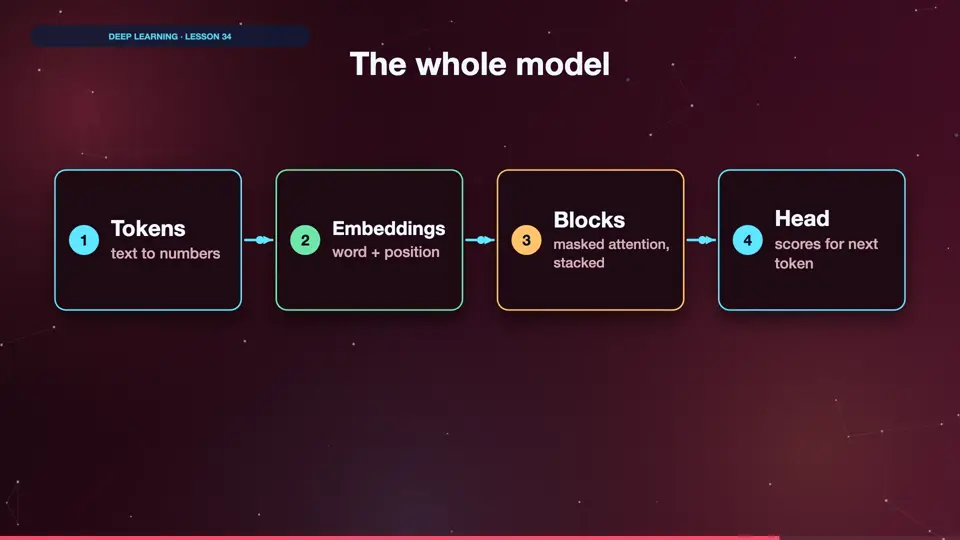
Here's the full path. Text becomes token numbers. Each token gets a word vector and a position vector. These flow through a stack of transformer blocks, with a mask, so that no word can see the future. A final linear layer gives a score for every possible next token. That's all a GPT is. A machine that predicts the next token.
- Tokenstext to numbers
- Embeddingsword + position
- Blocksmasked attention, stacked
- Headscores for next token
TinyGPT in forty lines
Here it is, all in one place. The block that we built. Then the model. Two embedding tables, a stack of blocks, a final norm, and a linear head. In forward, we add the embeddings, build the mask, run the blocks, and return scores. Run it. Our Tiny GPT has about three hundred thousand weights. GPT four style models have hundreds of billions or more, which is around a million times bigger. But the shape of the code is very much the same. Read those forty lines again, slowly. You've just written the architecture that changed the world.
import torch
from torch import nn

class Block(nn.Module):
    def __init__(self, dim, heads):
        super().__init__()
        self.attn = nn.MultiheadAttention(dim, heads, batch_first=True)
        self.mlp = nn.Sequential(nn.Linear(dim, 4 * dim), nn.GELU(),
                                 nn.Linear(4 * dim, dim))
        self.norm1, self.norm2 = nn.LayerNorm(dim), nn.LayerNorm(dim)

    def forward(self, x, mask):
        y = self.norm1(x)
        x = x + self.attn(y, y, y, attn_mask=mask, need_weights=False)[0]
        return x + self.mlp(self.norm2(x))

class TinyGPT(nn.Module):
    def __init__(self, vocab, block_size=64, dim=96, heads=4, layers=4):
        super().__init__()
        self.tok = nn.Embedding(vocab, dim)
        self.pos = nn.Embedding(block_size, dim)
        self.blocks = nn.ModuleList(Block(dim, heads) for _ in range(layers))
        self.norm = nn.LayerNorm(dim)
        self.head = nn.Linear(dim, vocab)

    def forward(self, ids):
        T = ids.size(1)
        x = self.tok(ids) + self.pos(torch.arange(T))
        mask = torch.triu(torch.ones(T, T, dtype=torch.bool), 1)
        for block in self.blocks:
            x = block(x, mask)
        return self.head(self.norm(x))

model = TinyGPT(vocab=65)
print("Weights:", sum(p.numel() for p in model.parameters()))
print("Output:", list(model(torch.zeros(2, 32, dtype=torch.long)).shape))Weights: 466241 Output: [2, 32, 65]
Summary
In forty lines, you've built a GPT. It only has random weights so far, so it can only produce noise. Next, we feed it real text, train it, and listen to it speak for the first time.
Key takeaways- GPT: predict the next token
- Forty lines, the real architecture
- Scale changes, the design doesn't