
Interview Questions, Part Two
System design.
Senior interviews often have a design round. They'll say something like, design a system to detect fraud. There's no single right answer. They're watching how you think. And you already know the framework, because you've used it all through this course.
- Design a fraud system
- No single right answer
- You know the framework
A framework for design questions
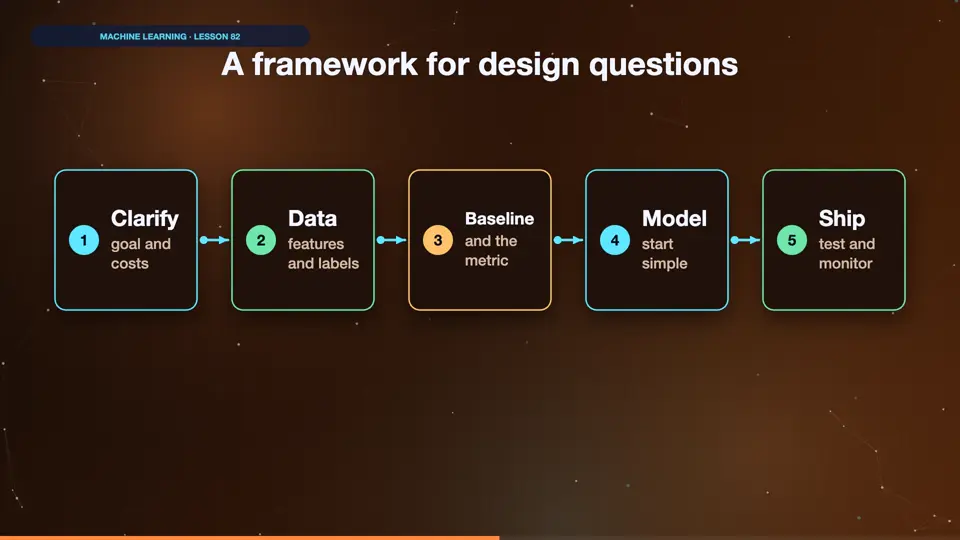
Follow six steps out loud. Clarify the goal, and ask about the costs of each mistake. Define the data, and how labels are obtained. Choose a baseline, and a metric. Propose features and a model, and start simple. Plan how to test it, offline and then in a live experiment. And finally, cover deployment, monitoring, and retraining. Talking through these steps calmly will put you far ahead of most candidates.
- Clarifygoal and costs
- Datafeatures and labels
- Baselineand the metric
- Modelstart simple
- Shiptest and monitor
Example: design a fraud detector
Let's practise. The goal is to block fraud, without annoying good customers, so we ask about the cost of each error. Labels come from chargebacks, which arrive weeks later, so training data is delayed. Fraud is rare, so we use precision recall. Features include spending compared to the customer's normal behaviour. We start with boosting. We split by time, because criminals adapt. And we monitor for drift, and send borderline cases to human reviewers.
Questions to ask them
At the end, you'll be asked if you have any questions. Don't say no. Ask, how do you measure whether a model is working in production? Who owns a model after launch? How long does it take to get a new model live? What's the most valuable model that you've retired, and why? These show that you understand the real job, beyond the algorithms.
Summary
Now you can walk into an interview with a real plan. You also have two projects to talk about, HomeWorth and churn. Next, let's put the entire course on a single page, with your cheat sheet.
Key takeaways- Clarify before you solve
- Follow the same framework
- Ask good questions back