
Big O Rules
Drop constants, keep the biggest.
Working out Big O is easier than it looks. There are just two rules. Drop the constants, and keep only the biggest term. Let's see why they make sense.
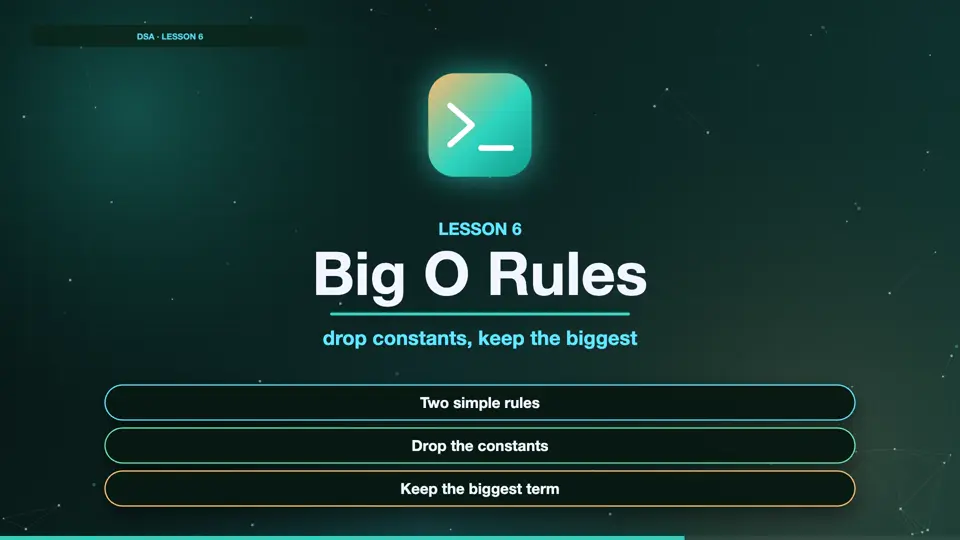
- Two simple rules
- Drop the constants
- Keep the biggest term
Two loops in a row
This function loops over the list twice, once to find the smallest number, and once to find the biggest. That's two N steps. But Big O drops the two, because doubling doesn't change the shape of the growth. It's still O of N. Run it.
def min_and_max(numbers):
    smallest = numbers[0]
    for n in numbers:
        smallest = min(smallest, n)
    largest = numbers[0]
    for n in numbers:
        largest = max(largest, n)
    return smallest, largest

print(min_and_max([5, 3, 9, 1, 7]))(1, 9)
Keep the biggest term
If code has a loop, and then a loop inside a loop, that's N plus N squared steps. When N is a million, N squared is so big that the plain N doesn't matter at all. So we keep only the biggest term. O of N squared.
Summary
Drop constants, and keep the biggest term. Two loops in a row is O of N. A loop inside a loop is O of N squared. Next, we'll see each one in real code.
Key takeaways- Drop constants
- Keep the biggest term
- 2n → O(n)